HAPPY NEW YEAR
I hope you had a wonderful Christmas and New Year and are ready for everything that 2015 has to offer. We had a lovely quiet Christmas which was much needed followed by my best friends wedding (link to the photos to follow soon) and a quiet New Year with a few drinks and Chinese takeaway with some friends. After a much needed break it is time to hit the ground running with so many exciting things planned for this year including sharing some more of my favourite images animal by animal and next up is the adorable Rock or Cape Hyrax (Procavia capensis).
The Cape hyrax also known as a dassie, is one of only four extant species in the order Hyracoidea and the only living species in the Genus Procavia. Despite looking like a small rodent, the closest living relatives of the hyrax are actually elephants and manatees and they have the most adorable little faces and characters.
On an early morning trip to a location to look for penguins, this small group of hyrax where on the rocks just before the main penguin colony and getting there nice and early they were quite curious about that strange thing pointing something at them.
This first image is of two hyrax sitting on the rocks, they have moist rubber soles to their feet which help them with their lives on the rocks and they love basking in the sun!
These next few images are of one rather inquisitive individual who I just adore, so much personality in something so small.
This last image was one I took on the way back from the penguins just sprawled out on the rocks watching the world go by, you can see their rubbery feet which are so vital when climbing around steep rock faces.
I really enjoyed the short time I had with this family but would love the opportunity to return and spend longer photographing the lives of these wonderful creatures around South Africa.
I hope you have enjoyed my images of the hyrax, still to come are penguins and a chameleon, but for now it's time to get back to processing the wedding photos.
Have a lovely day.
Victoria x
Showing posts with label canon. Show all posts
Friday, 2 January 2015
Monday, 25 August 2014
Grasshoppers, Nothing But Lovely Grasshoppers
Hello! Hope you are all well and have been enjoying summer (although today is most certainly an office day!), well I have been out and about a fair amount lately continuing with both my Somerset, Chapmanslade and invertebrate projects which are all coming together nicely, but as the title of this post may suggest there is nothing but grasshoppers here!
People often ask me why grasshoppers, and indeed just the other day a lovely chap who was out walking his dog asked what I was photographing, was it butterflies? When I reply no he asked if it was dragonflies, again I said no and when I said grasshoppers he seemed very surprised replying "you don't often hear of people photographing grasshoppers people normally come here for the butterflies and dragonflies, why grasshoppers?" Well here is why: Last year I took what still remains one of my favourite images of a grasshopper and it was completely by chance as I had planned that day specifically to photograph orchids, before I go any further here is that photo:
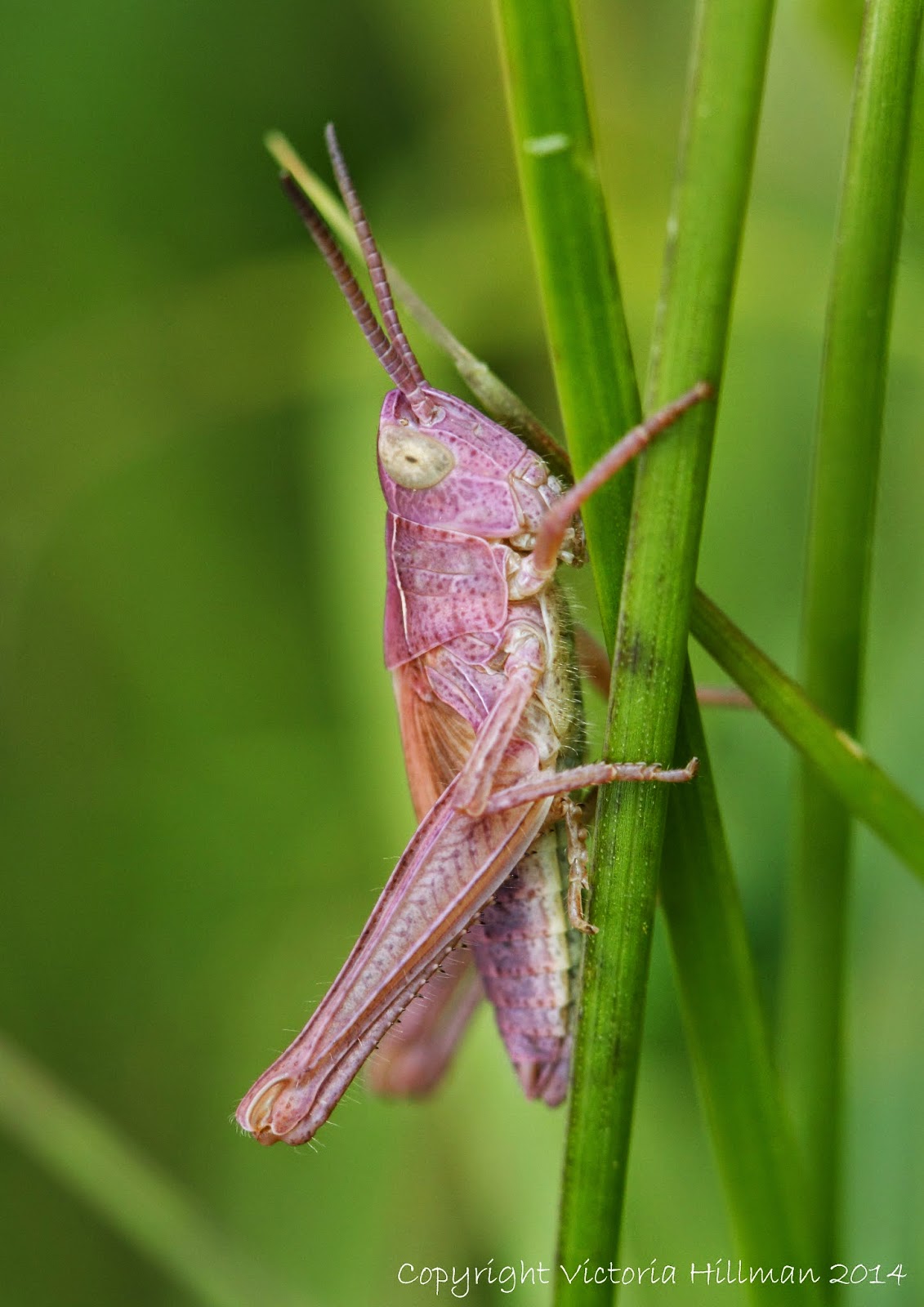
I was actually photographing bee orchids when I noticed this grasshopper watching me, so my focus turned to trying to capture the expression on its face, and it was at this point that I fell in love with grasshoppers and wanted to really showcase how cute they are! And really that's it, I wasn't able to do much last year due to other work commitments but this year I have been out looking for them in numerous locations looking for different ways to capture their lives and comical facial expressions, during this time I have also been fascinated by the variety of colours and markings that they come in, including would you believe pink, orange and white! So here are the pink grasshopper (more about these later in the post including an explanation), the tango'd grasshopper and the ghost grasshopper (names I have given them).
Away from the colours, there are so many creative photographic opportunities to be had. The next two images show two very different angles, the first (which is a Rufous Grasshopper Gomphocerippus rufus) peering over the top of a dead plant head. This was a difficult image to capture in focus as the head is not the biggest area to focus on plus on that day it was particularly windy!
The second image, again a very tricky one to capture in focus (there were many failed attempts due to the wind) but also there were a couple of different compositions that I tried out and this one sticks out for me above the others. As you may be starting to notice by now I like to have a lot of space around my subjects when composing my creative shots but for me this helps to give a sense of place more than the close up images.
Now, as promised earlier in the post some more details about the pink grasshoppers. So why are they pink?
Well, it is actually a little understood genetic mutation caused by a recessive gene similar to that which affects albino animals and is called erythrism. The mutation results in one of two things happening or a combination of the two: you get a reduction or even absence of the normal pigment and/or the excessive production of other pigments, in this case red which results in pink or sometimes purple morphs. Although the condition was first discovered in 1887 in a katydid species, it is still rare and not often seen. although there are more reports of them coming in but this could be that people are now actually looking for them!
So here are a couple more images of the pink grasshoppers I found in one particular location, I will be back next year to see if I can find some more!
I promise these haven't been altered in any way, they really are that colour!
Right time for me to go and get on with writing an article about a bag, coming soon will be some beautiful butterflies like you have never seen them before! Bye for now and have a wonderful evening.
Victoria
Wednesday, 6 August 2014
Orchids
Hello again, I hope you enjoyed my post on adders I will be continuing to work with these over the coming years, there is still the grasshoppers to come (including some pink and oranges ones!) but this post is all about orchids. Unfortunately I have been a bit strapped for time to get out to photograph orchids this year due to other work commitments and their short flower period but I have managed a couple of trips that have been wonderfully successful to both old favourite spots and brand new ones.
I have found orchids in woodlands, fields and grassland and really looked at things differently this year as part of my Somerset Project. Instead of just taking beautiful pictures, I have both taken a step back and shown them in their habitat and got up close and personal to show their textures, so here are some of my favourite images.
Bee orchid - Ophrys apifera

Green-winged orchid - Anacamptis morio, both the normal purple variation and the much paler pink variation, both were in abundance at this new site.


Early Purple Orchid - Orchis mascula


Greater Butterfly Orchid - Plantanthera chlorantha
Common Spotted Orchid - Dactylorhiza fuchsii
Unknown orchid - I found this close to greater butterfly orchids but it doesn't look anything like them and can't find anything that looks similar so if anyone can help with an identification that would be lovely.
Well, that's it for orchids for now at least! These for part of my on-going project capturing the smaller things in Somerset and I'm hoping to produce a wonderful book to accompany the project which will be full of photos and the stories behind them but I have a way to go before that stage!
Next up will be grasshoppers and my work with them and then a new project based just down the road in Wiltshire which I have just started but very excited about. I'm heading away for 10 days but there will be plenty more when I get back and lots of new images from a different part of the UK.
For now, thank you for reading, please share with friends and family and take care.
Victoria x
I have found orchids in woodlands, fields and grassland and really looked at things differently this year as part of my Somerset Project. Instead of just taking beautiful pictures, I have both taken a step back and shown them in their habitat and got up close and personal to show their textures, so here are some of my favourite images.
Bee orchid - Ophrys apifera

Green-winged orchid - Anacamptis morio, both the normal purple variation and the much paler pink variation, both were in abundance at this new site.


Early Purple Orchid - Orchis mascula


Greater Butterfly Orchid - Plantanthera chlorantha
Common Spotted Orchid - Dactylorhiza fuchsii
Unknown orchid - I found this close to greater butterfly orchids but it doesn't look anything like them and can't find anything that looks similar so if anyone can help with an identification that would be lovely.
Well, that's it for orchids for now at least! These for part of my on-going project capturing the smaller things in Somerset and I'm hoping to produce a wonderful book to accompany the project which will be full of photos and the stories behind them but I have a way to go before that stage!
Next up will be grasshoppers and my work with them and then a new project based just down the road in Wiltshire which I have just started but very excited about. I'm heading away for 10 days but there will be plenty more when I get back and lots of new images from a different part of the UK.
For now, thank you for reading, please share with friends and family and take care.
Victoria x
Labels:
7D,
bee orchid,
british,
canon,
common spotted orchid,
early purple orchid,
flowers,
greater butterfly orchid,
macro,
orchids,
photography,
somerset,
Somerset project,
victoria hillman,
vikspics,
woodland
Subscribe to:
Posts (Atom)


